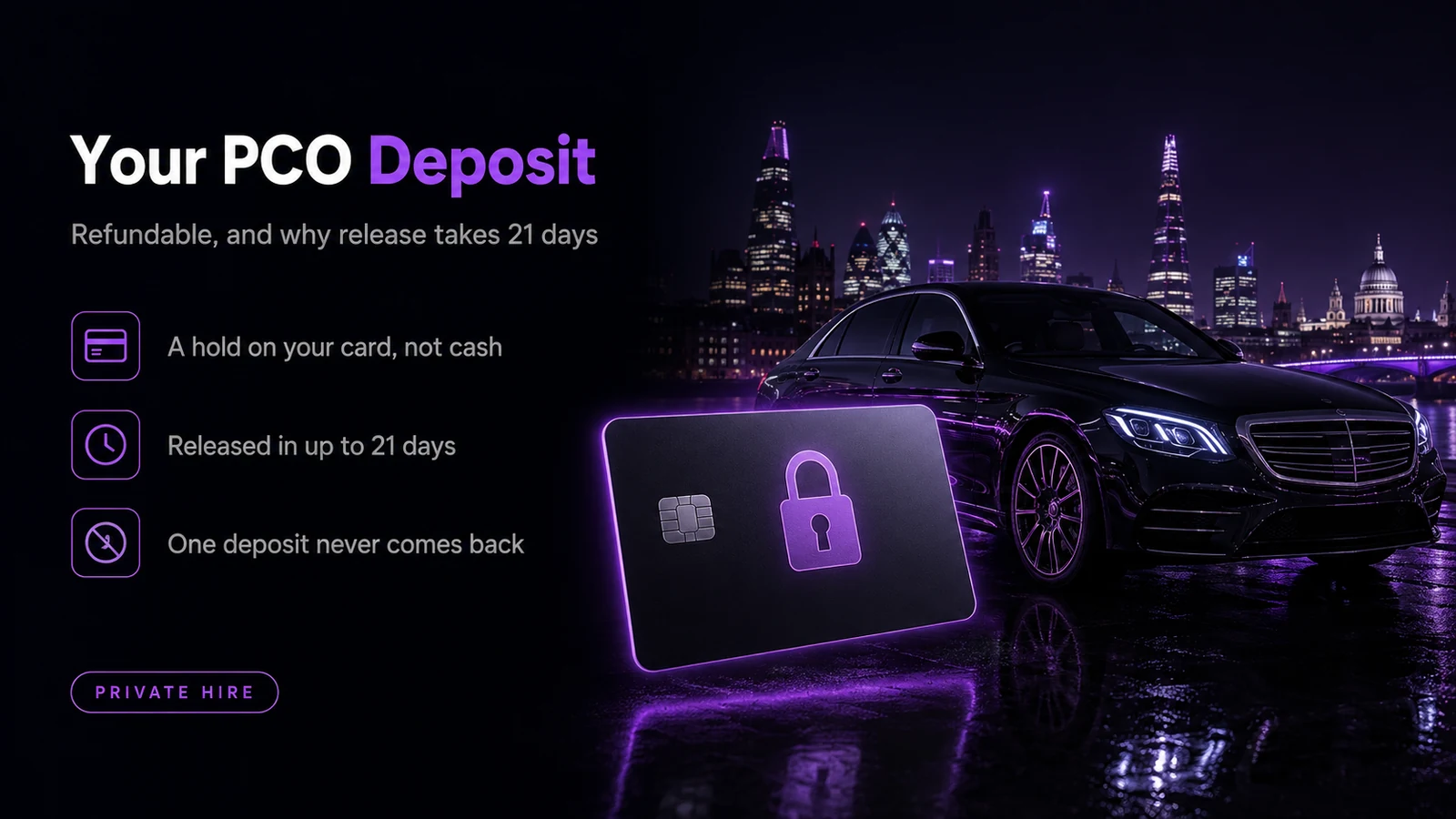
Here's what we hold when you drive off in a Blackties car, why we hold it and how you get it back. No jargon, no small print you only meet on return day. A deposit should be the least mysterious part of hiring a car.
It's a hold, not a charge
When you collect the vehicle, we place an authorised hold on your payment card. Our contract calls it exactly what it is: "not a charge or payment, but a temporary freeze of available credit to secure potential liability during the rental period."
In plain English, we ring-fence some headroom on your card so no cash leaves your account; the balance is reserved, then released.
The exact amount is set per rental and printed on your contract before you sign. It can't surprise you later, because you've already put your name to it.
And it's refundable. On return you are "entitled to any Holding Deposit less all deductions for charges, damage, or outstanding fees." You get it back minus only what you actually owe.
What can be deducted, and the evidence behind it
Every deduction has to be backed by a written record. At handover we complete a Vehicle Damage Sheet and photograph the car's condition and its fuel level, so both sides start from a baseline neither can argue with later.
Three things only ever come out of your deposit:
- Customer-caused damage you're responsible for
- Outstanding charges such as fuel, fines and tolls
- Unpaid fees from the hire
Fair wear and tear is never charged. We follow the BVRLA fair wear and tear guidelines, so light scuffs and everyday marks on a working PCO car are on us. Every deduction is itemised against that damage sheet; you can see exactly what it's for.
Why release can take up to 21 days
It's the question drivers ask us most.
Releasing your deposit can take up to 21 days after you hand the car back. The wait is the late-charge window at work, because PCNs, bus-lane tickets, congestion and ULEZ charges and tolls from your final days of hire often don't reach us, the registered keeper, until weeks later.
As registered keeper we can't always transfer that ticket onto the driver, and our contract is explicit: "if transfer fails for any reason, the renter remains fully liable for the entire PCN amount." Throughout your hire you carry "full and unlimited liability for all PCNs, parking fines, traffic violations, toll charges, congestion charges." So we hold the deposit until that window clears and then release the balance to you. We're not sitting on your money.
Fuel: one level, written down
The car leaves at a stated fuel level, recorded on the Vehicle Damage Sheet at collection, and it has to come back at that same minimum. Return it lower and the charge is the cost of the fuel plus a £15 service fee. The handover level is written on your contract, so nothing is hidden.
The rest of the fee list
It's short, because for most drivers none of it applies:
- PCN admin fee: £15 per PCN, fully refunded if you appeal successfully and send us the issuing authority's written confirmation it was cancelled.
- Accident excess: £750, payable immediately regardless of fault; if you're not at fault, we pursue the insurer to recover it.
- Non-reported damage: £3,000 excess, and only where significant damage you didn't report is found.
- Windscreen: capped at £250.
- Excess mileage: charged per mile at the rate printed on your contract.
We provide fully comprehensive insurance. The deposit is only ever forfeited in full for a serious breach, and that means tampering with the telematics tracker, unauthorised driving, or termination for cause. A normal return never forfeits it.
The one deposit you never get back
Everything above is about renting. Rent-to-buy is a different product and the "deposit" there works nothing like this, so the difference is worth understanding, even though it's an industry contrast rather than something we're selling here.
A rent-to-buy (or rent-to-own) down payment is non-refundable. Full stop. Since nothing is being held as security, the money goes in as a capital contribution towards the purchase price, equity you're putting into a car you're buying, plus consideration for the provider taking that vehicle off the market for a multi-year term. Because it's applied to the car rather than held against damage, it's gone if you exit early.
That's the sharpest line between the two models. Rent a car and your deposit comes back; commit to buying one and it doesn't. If you want the full picture, read what rent-to-buy really is and our breakdown of rent or rent-to-buy.
The line to remember
A rental deposit is a hold that frees up on its own, while a rent-to-buy down payment is money you've already spent on a car. Same word, opposite outcomes. With us, the exact deposit amount, the excess-mileage rate and the fuel level are all printed on your contract before you sign, so there are no surprises after. New to the trade? Start with how to get your PCO licence in London.