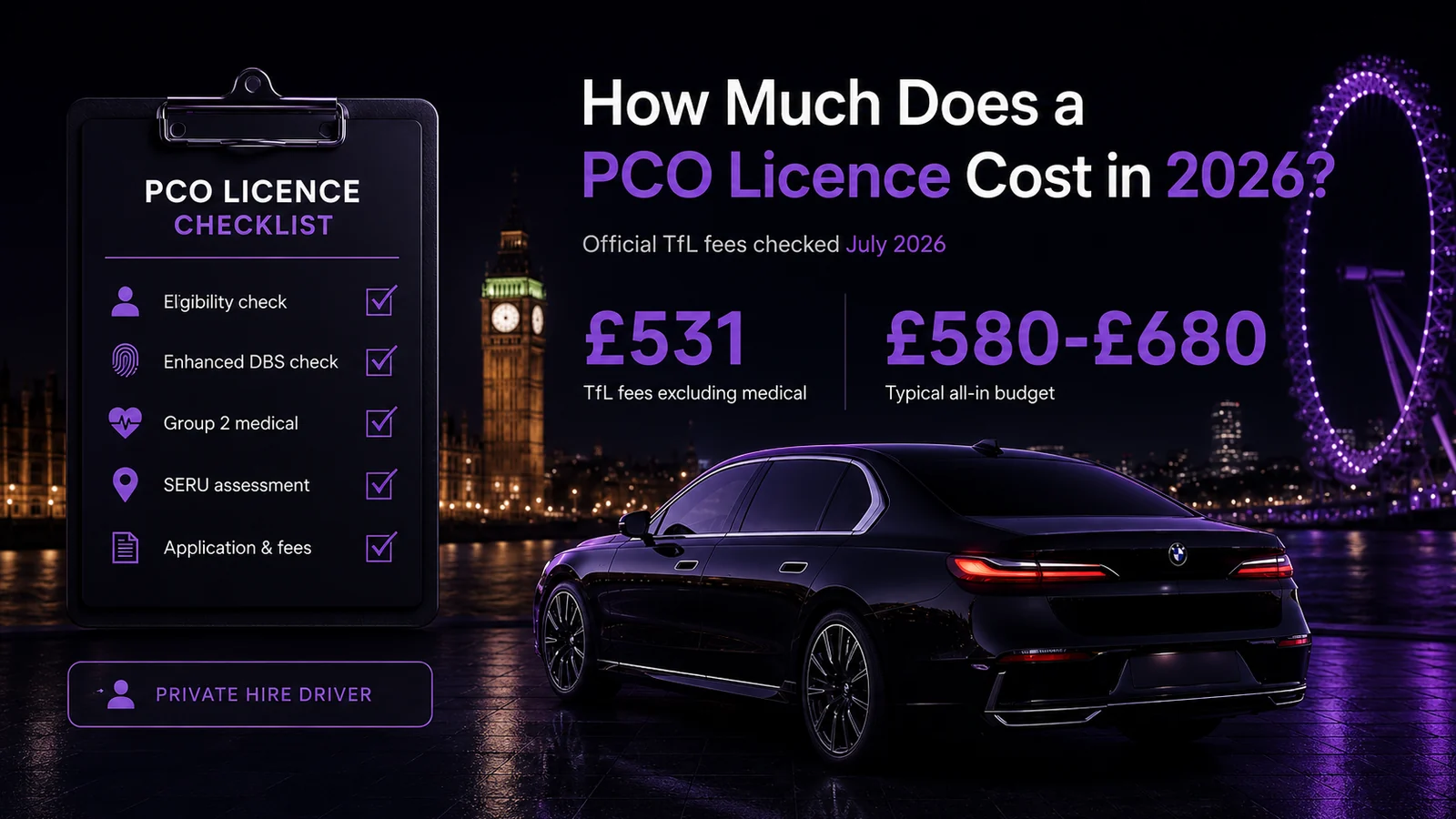
TfL calls it a private hire driver licence. Drivers call it a PCO licence, or simply the green badge. Whatever you call it, you cannot carry a single paying passenger in London without one, and in 2026 it costs more than most guides admit. TfL raised its assessment fees in March 2026 and its licence fees on 1 June 2026, the first licence fee rise since 2017, yet most of the guides you will find online still quote the old numbers. Every figure below was checked against official TfL sources in July 2026, so you can budget properly and avoid the delays that catch out new applicants every year.
Check you qualify before you spend a penny
The TfL private hire driver licence page sets out the entry requirements. You must be at least 21 when you apply, with no upper age limit. You must hold a full DVLA, Northern Ireland or EEA driving licence that is at least three years old. Time spent driving on a non-UK licence before you exchanged it does not count towards the three years, which surprises a lot of experienced drivers who moved here recently.
You also need the right to live and work in the UK. You prove it either with an online share code or with original documents, as set out in the Home Office guidance for licensing authorities. If your permission to stay is time limited, your licence cannot outlast it. Finally, you must be of good character. A private hire licence normally lasts three years once granted, although TfL can issue shorter licences in some circumstances.
The enhanced DBS check
Every applicant needs an enhanced criminal record check, and you cannot bring your own certificate. It must go through TfL's authorised provider, First Advantage, via its KnowYourPeople platform, at £52 online or £54 on paper. You must also register with the DBS Update Service at £16 per year, which lets TfL re-check your status without a fresh certificate. Keep that subscription live for as long as you hold the badge.
If you have lived outside the UK, you must also supply a certificate of good conduct from that country's authorities, translated into English where necessary, as set out in TfL's certificates of good conduct guidance. Foreign authorities can take weeks to issue one, so request it on day one alongside your GP records.
The check reveals spent and unspent convictions, cautions and relevant police intelligence. TfL decides case by case, but approval is unlikely if you have serious violent or sexual offences, appear on a barred list, or have touting convictions. Once licensed, you must tell TfL within 48 hours if you are arrested and released, charged, cautioned or convicted of anything, including motoring offences that add penalty points. The 48 hour rule applies to licences granted since 1 July 2024.
The medical: Group 2 standards on the TPH/204 form
TfL assesses your fitness against the DVLA Group 2 standard, the same bar as bus and lorry drivers, using the TPH/204 medical declaration. The form must be completed by a doctor who has access to your full medical records, usually your own GP, after an in-person examination. Every page needs the doctor's signature, a surgery stamp and a date, and every question must be answered, or the form is invalid. One useful exception sits on the form itself: if you already hold a valid DVLA Group 2 bus or lorry licence, you do not need to complete the TPH/204 at all.
The NHS will not cover the fee, and the price is set by the examining doctor rather than TfL. As of July 2026 the market runs from roughly £45 to £150 depending on the provider: budget clinics advertise around £45, Doctorcall runs TfL medicals at Uber's Greenlight Hub in London for £90, and premium central London clinics charge £120 or more. The doctor must confirm on the form how they accessed your full medical records, so private providers will only sign it if you supply your full GP record, and most will not accept summary printouts or NHS App screenshots, so request your records early. The exam covers cardiovascular health, diabetes, neurological conditions, vision and mental health. If any answer is yes, the doctor must attach the specialist evidence listed in the DVLA fitness to drive guidance. Missing reports are one of the most common causes of TfL asking for more information and stalling your file.
The three TfL assessments: English, SERU and topographical
Everyone applying since 1 April 2023 must meet the English language requirement, which is made up of two assessments, both set at an intermediate level widely described as equivalent to CEFR B1. You will also sit a third test, the topographical skills assessment. Full details are on the TfL English language requirement page.
The speaking and listening test
A 15 to 20 minute conversation, taken at a TfL Driver Assessment Centre via a secure video or phone link to LanguageCert, part of PeopleCert. It costs £40 for a first attempt and £30 for a resit.
The SERU assessment
The SERU assessment covers safety, equality and regulatory understanding, and doubles as your reading and writing test. It is computer based, delivered by TfL staff at TfL offices, and uses multiple choice questions plus sentences with missing words. Also £40 first attempt, £30 for a resit. Every question comes from one document: the free PHV Driver's Handbook, which covers everything from licensing rules to safeguarding across its sections. Read it properly rather than cramming. TfL has stated in TPH Notice 01/24 that SERU was never intended as a memory test and has announced a trial of an open-book format, aimed at existing drivers who had not yet met the requirement. TfL's live pages do not yet confirm whether that format applies to new applicants, so prepare as if the assessment is closed book unless TfL tells you otherwise when you book. TfL also expects you to complete its free online Safeguarding Awareness training before you sit SERU. Once you pass, you do not currently need to retake it. If you need reasonable adjustments, email [email protected] with supporting documentation.
The topographical skills assessment
The third test checks that you can plan a sensible route between two points, read a map and its index, and understand London's geography at a working level. It costs £40 for a first attempt and £30 for a resit, the same pricing as the other two assessments under TPH Notice 05/26, and you book it through the same TfL portal.
Applying online and the real 2026 cost
Apply through the TfL Taxi and Private Hire online portal, where you also book and manage your assessments. There is also an HMRC step set out on the TfL licence page: first-time applicants must confirm they are aware of their tax obligations, while anyone who has held a taxi or private hire licence in the last 12 months, with TfL or any other authority, must complete an HMRC tax check on gov.uk and give TfL the code before the application can be processed.
Here is the full current fee schedule, updated per TPH Notice 05/26:
- Application fee: £138, non-refundable, up from £124 on 1 June 2026
- Grant of licence fee: £205, paid when the licence is granted
- Enhanced DBS check: £52 online, £54 paper
- DBS Update Service: £16 per year
- SERU assessment: £40, resit £30
- Speaking and listening assessment: £40, resit £30
- Topographical assessment: £40, resit £30
- Medical: set by the examining doctor, typically £45 to £150 TfL's own worked example comes to £531 excluding the medical. Add a realistic medical fee and your true all-in budget is roughly £580 to £680, assuming you pass everything first time. Any guide still quoting a total near £400 is working from the pre-2026 fee schedule.
How long does it actually take?
TfL publishes no fixed end-to-end timescale and openly warns that new applications are taking longer than normal. The most recent service update, TPH Notice 06/26 from March 2026, says initial review of a new application happens within 10 working days, assessment bookings are available without delay, but a backlog exists at the final review stage, worked through in date order of assessment results. GP availability and DBS processing sit outside TfL's control and can add weeks. Plan in months, not weeks: request your GP records on day one, book your medical and assessments as early as TfL allows, and do not hand in your notice against a promised start date.
Your first car: the decision that sets your earnings
Why most new drivers rent rather than buy
The driver licence and the vehicle licence are separate, and the vehicle rules push hard against buying. Under TfL's emissions standards, any car licensed as a London PHV for the first time must be zero emission capable and Euro 6, which in practice means a full electric car or a qualifying plug-in hybrid. Cars already licensed age out at 10 years at re-licensing. A buyer must then add hire and reward insurance, typically £1,500 to £3,000 a year depending on experience, plus the £84 application and £56 grant fees for the vehicle licence, an MOT issued within 14 days of the inspection, and all servicing.
Renting bundles the lot into one weekly payment, and a third route sits between renting and buying: rent-to-buy PCO car hire, where you hire weekly on a fixed term of two to five years and the car is contracted to become yours at the end. In mid-2026, standard PCO-ready cars are advertised at roughly £190 to £290 per week with insurance and maintenance included, with some entry electric plans from £104. Executive cars such as a Mercedes E-Class run about £250 to £330 per week. Factor in running costs too: the Congestion Charge is £18 per day if you pay in advance or on the day, rising to £21 if you pay late, and PHVs are not exempt, though an electric car registered for Auto Pay gets 25 per cent off and pays around £13.50. Any ZEC-compliant car already meets ULEZ standards, so the £12.50 ULEZ charge will not touch you.
What Uber Exec and Lux actually require
The executive tiers are where the car choice really bites. Per Uber's vehicle requirements, Exec needs a driver rating of 4.85 or above, while Lux, which launched in London, needs a 4.9 rating and over 1,000 completed trips. That page requires a Mercedes-Benz, BMW, Audi, Jaguar or Lexus saloon, no estates, in black, grey, blue, dark blue or dark grey, five years old or newer in London and applied on a rolling basis.
The Lux list on Uber's eligible vehicles page for London is short, and it includes the BMW 7 Series and BMW i7 alongside the S-Class and EQS, plus a handful of marques beyond the core brands, such as Bentley and Rolls-Royce, at the very top. The E-Class and 5 Series qualify for Exec only. The same page states that from 1 January 2026, vehicles must be registered from 1 January 2020 or later. Uber has also announced updated eligibility rules for vehicles added from 1 August 2026, so check the live list before committing to anything. We have set the new brand, colour, body style and age criteria against the old ones in full.
Why the badge is the same but the earnings are not
Your licence, your hours and your costs of getting licensed are identical whether you end up on UberX or Lux. The fare tier is not. Uber publishes no official earnings comparison, but executive and luxury fares clearly price well above standard trips, which is why drivers who can access the top tiers chase them. A 7 Series or i7 opens both Exec and Lux from day one of eligibility, while a cheaper car keeps you on standard fares until you replace it. Which of the two flagships suits you comes down to whether you can charge reliably and how much of your week runs out of town, which is the comparison we make in BMW i7 against Mercedes S580Le for London PCO drivers. That is the whole logic behind the Blackties fleet: BMW i7, 7 Series and i5, plus Mercedes-Benz E-Class, EQE and S580e, specced to meet the executive tier rules, with the weekly numbers set out in our driver benefits section.
Mistakes that cost applicants months
- Getting the medical done by a doctor without your full records. TfL warns this delays applications, and some get rejected outright.
- Submitting a TPH/204 with unanswered questions or missing surgery stamps, which makes the form invalid.
- Skipping the free Safeguarding Awareness training TfL expects you to complete before sitting SERU.
- Cramming SERU practice questions instead of reading the handbook the questions actually come from.
- Letting the £16 DBS Update Service subscription lapse.
- Budgeting from stale articles quoting £124 and £186. The 2026 fees are £138 and £205.
- Buying a petrol or diesel car that can never be licensed as a new London PHV under the ZEC rules. Signing a three or four year rent-to-buy agreement in your first month, before you know the work suits you and before you have read what rent-to-buy PCO car hire actually commits you to.
Quick answers
How much does a PCO licence cost in 2026?
£531 in TfL fees excluding the medical, per TfL's own example. With a typical medical, budget roughly £580 to £680, plus resit fees if you fail any assessment.
How long does it take to get a PCO licence?
TfL publishes no fixed figure. Initial review takes up to 10 working days, then assessments, then a final review stage with a known backlog. Realistically, plan for several months and start your medical records request immediately.
Do I need my own car before applying?
No. The driver and vehicle licences are separate, and you can apply without any car. Most new drivers rent a PCO-ready vehicle once the badge arrives, either on a straight weekly rental or on rent-to-buy PCO car hire, where the weekly payments are contracted to end in ownership after two to five years.
Can I get a PCO licence with points on my licence?
TfL publishes no fixed points threshold and assesses every applicant case by case under its good character policy. Declare everything honestly, because undeclared history is far more damaging than the points themselves. Serious violent or sexual offences make approval unlikely.
What happens if I fail the SERU assessment?
You book and pay for a resit at £30. TfL's live pages publish no attempt limit, but your licence will not be granted until you pass, so treat the handbook as required reading, not optional revision.
Get the badge, then get the right car
The licence process is the same for everyone. What you drive afterwards is the difference between standard fares and executive ones. Blackties puts new badge holders straight into Exec and Lux eligible cars without the capital outlay. Join the waiting list so a car is ready when your badge lands, or register an account and pick your car while TfL works through your application.
Once the badge is sorted, the vehicle has its own annual hurdle. What TfL checks at the licensing inspection has the 2026 fees and the published failure thresholds.