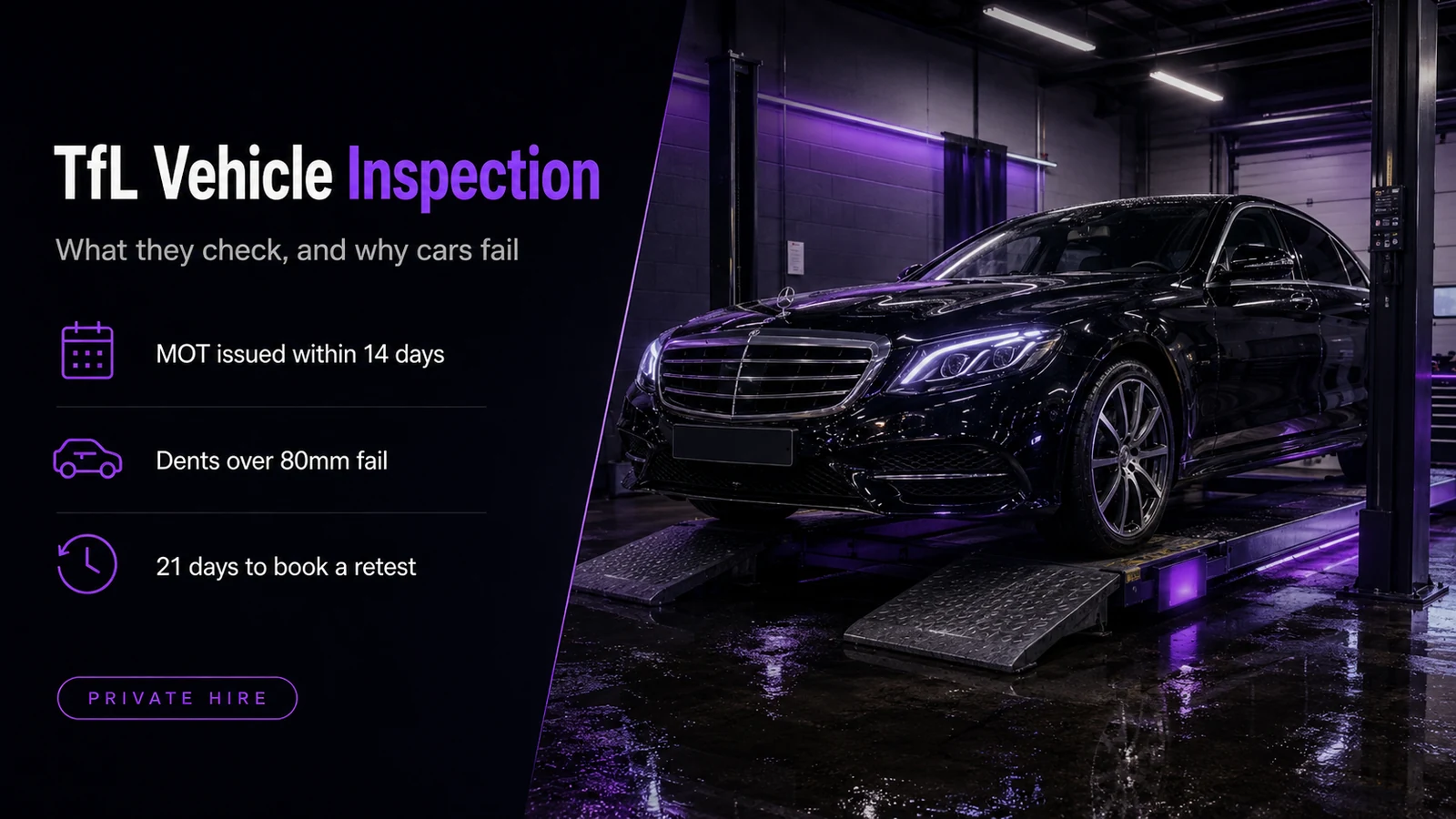
The TfL licensing inspection is not an MOT. Your car can pass its MOT in the morning and fail the licensing inspection in the afternoon, on items the MOT does not test and thresholds the MOT does not use. Knowing what is actually checked, and what the published failure limits are, is the difference between one visit and three. Everything below comes from TfL's own inspection manual and licensing pages, checked on 4 August 2026.
What the inspection is, and what governs it
Every London private hire vehicle licence lasts one year, or less if TfL thinks it appropriate, under section 7(6) of the Private Hire Vehicles (London) Act 1998. That annual expiry is why the inspection is annual.
The rules live in TfL's Taxi and Private Hire Vehicle Licensing Inspection Manual, version 20, dated 20 March 2026. It runs to 66 pages and it is public. If you are about to present a car, it is the single most useful document you can read.
One clarification that saves confusion: a private hire vehicle is assessed against the Private Hire Vehicles (London PHV Licences) Regulations 2004 as amended. The Conditions of Fitness 2007, which people quote constantly, apply to black cabs, not to you.
Where it happens and what it costs
Licensing inspections are carried out only at sites TfL authorises, and a full inspection can only be done inside an approved workshop with a vehicle ramp, so an underside inspection can be carried out where required.
As at August 2026 there are five inspection sites: Enfield, Heston, Staples Corner, Rainham and Sidcup.
The fees are the good news this year. The PHV vehicle licence application fee is £84 and is non-refundable, and the grant of licence fee is £56, so £140 in total.
TfL changed taxi and private hire fees in 2026, the first change since 2017, approved by its Finance Committee on 25 February 2026. The PHV vehicle licence fees were explicitly left alone. What did rise, on 1 June 2026, was the PHV driver licence: application from £124 to £138, and grant from £186 to £205. Driver assessment fees rose earlier, on 9 March 2026, with the topographical skills, English language and SERU assessments all going from £36 to £40, and resits from £16 to £30.
So if someone tells you the vehicle inspection got more expensive this year, they have confused it with the driver licence. Our PCO licence guide has the full set of 2026 driver figures.
The fifteen sections
The manual inspects in fifteen numbered sections: Documents, Whole Vehicle Type Approval, Interior Compartment, Obligatory Lamps and Lenses, Engine Compartment, Condition of Bodywork and Paintwork, Road Tyres and Wheels, Underside Inspection, and onward through the remaining mechanical and safety groups.
Two of those account for a disproportionate share of failures, and neither is mechanical. They are Documents and Bodywork.
Documents, and the fourteen day trap
Bring originals. Printed, physical documents. Electronic copies are not accepted, and turning up with a PDF on your phone is a wasted appointment.
You need your existing TfL vehicle licence and discs, the V5C, hire and reward insurance documents, an MOT certificate issued within the last 14 days, and paperwork for any modifications.
That fourteen day window is the one that ruins appointments. It counts the inspection date as day one. An MOT that is perfectly valid for another eleven months is still refused if it was issued fifteen days ago. Book the MOT to sit just inside the window, not whenever is convenient.
Private hire vehicles more than 12 months from manufacture also need two MOTs a year as a condition of continued licensing, with the second obtained around six months after the first.
TfL refuses on document detail as well as absence: a fleet V5 printout more than 14 days old, a V5C that is not the current document, a V5C with discrepancies, or owner details that do not match TfL's records. On a leased or rented vehicle, TfL additionally checks that the lease agreement permits passenger hire and reward journeys.
An MOT pass does not mean an inspection pass
This is the part drivers find hardest to believe, so it is worth stating precisely.
Unrectified MOT minor defects can be failed at the licensing inspection. An MOT certificate identifying a safety critical advisory can also cause a failure. The MOT records the advisory and lets you drive away. TfL does not have to.
So the sequence that works is: MOT first, fix everything the MOT raised including advisories and minors, then present for licensing inside the fourteen days. The sequence that fails is: MOT passes with advisories, drive straight to the inspection, get refused for the advisory.
Bodywork, measured not judged
Condition of Bodywork and Paintwork is section 6, and TfL publishes numbers rather than leaving it to opinion.
You are refused for a single dent of more than 80mm in diameter, or more than three dents of 20mm or more in any one panel. You are refused for more than four scratches or abrasions of more than 50mm in length in any one panel.
Stone chips have their own thresholds: more than 16 visible on the bonnet or grill that have not penetrated to the metal, more than six that have, or more than eight on any panel where the primer coat has been exposed.
Repairs are inspected as closely as damage. Refusal follows evidence of crudely repaired or insecure body panels, including paint runs and overspray. A rushed respray before an inspection can fail a car that would have passed with the original scratches.
Take a tape measure to your own car before you take it to Heston. Eighty millimetres is smaller than it sounds.
Other common failure points
Tint. TfL requires 75% of light to be transmitted through the front windscreen and 70% through the front side windows. Manufacturer tint counts towards the total, so aftermarket film on the front sides will usually fail even if it looks light.
Doors. Where a private hire vehicle has only one passenger door, it must be on the nearside. An offside only passenger door is a refusal.
Seating. Passenger seating capacity including wheelchair positions must not exceed eight.
Seven seaters. TfL Notice 01/26 of 7 January 2026 restricts seven seaters whose rearmost seats cannot be reached from the kerbside. Those vehicles are licensed to carry a maximum of four passengers, and the rearmost seats must be folded down whenever the vehicle is in use.
Right hand drive. All PHVs must be right hand drive, with exemptions considered only on the narrow grounds TfL publishes.
Cameras. A dashcam or CCTV system is treated as a vehicle modification, so it needs TfL's approval before it is fitted, and "Unapproved modification fitted" is its own refusal reason. Missing or illegible camera signage is a separate one again. The rules catch ordinary forward facing dashcams, not just passenger cameras, and they rule out suction mounts outright. What you can actually fit is here.
Salvage. Evidence on the V5C that the vehicle has been salvaged is a refusal reason, and structural salvage noted on page one is referred onward. TfL is consulting on going further and refusing every salvage category outright, which we covered in our piece on the proposed salvage ban.
If you fail
A failure is not the end of the licence, and there are four routes forward.
You can ask the inspection site team leader to reconsider, which is the informal appeal and costs nothing. You can book a retest. You can request a personal hearing. Or you can appeal to Westminster Magistrates' Court.
A PHV retest must be booked within 21 days of the first inspection. That window can be extended where specific repairs are needed, so if a part is on back order, say so rather than letting the clock run out.
Note the asymmetry: a taxi gets 28 days, a private hire vehicle gets 21.
TfL can act between inspections
The annual inspection is not the only moment of risk. Any defect found at any point during the licence period can lead to an unfit notice being served, prohibiting use of the vehicle until the defect is rectified.
In practical terms, the standard the inspection applies is the standard the vehicle has to meet all year, not once a year.
Frequently asked questions
How much is the TfL vehicle inspection in 2026?
£84 for the application, which is non-refundable, and £56 on grant, so £140 in total. These were not changed by the 2026 fee review. The PHV driver licence fees did rise on 1 June 2026.
Can I use my MOT certificate from last month?
No. TfL requires an MOT issued within the last 14 days, counting the inspection date as day one.
My car passed its MOT with advisories. Will it pass the inspection?
Not necessarily. Unrectified minor defects and safety critical advisories can both cause a licensing failure. Fix them before you present the car.
How long do I have to book a retest?
Twenty one days from the first inspection for a private hire vehicle, extendable if you need specific repairs done. Taxis get 28 days.
Do I need to bring paper documents?
Yes. Originals only. Electronic copies are not accepted.
How many inspection sites are there?
Five as at August 2026: Enfield, Heston, Staples Corner, Rainham and Sidcup.
A car that turns up ready
Most inspection failures are preventable and administrative rather than mechanical: the wrong MOT date, a mismatched V5C, a lease that does not permit hire and reward, four scratches that should have been three.
Blackties handles all of it. Every car in the fleet is presented, inspected and re-licensed by us, on a lease written to permit hire and reward, so the inspection is our problem rather than yours. See the fleet or register an account.
If you are still working through the driver side, start with the PCO licence guide and the topographical test. If your car has already been refused, the nine most common rejection reasons covers both the TfL and Uber sides.